
Spektreworks
The Bootstrapped Startup That Just Bombed Iran


I don’t write about this subject lightly.
I have many torn feelings about the ongoing war between the U.S. and Iran (and it is a war no matter how you spin it).
There are far better talking heads in the foreign policy space that can talk about the legality (it isn’t), the strategy (there is none), or where we go from here (no one knows) so I will leave that to the experts.
Writing about investing in the national security space at a weekly cadence, brings with it the inherent possibility that you will be writing during conflict, and since I have always tried to focus this newsletter to be useful for investors and builders I know that this could come off as crass, war mongering or profiting off the tragedy of others. That is certainly not my intention.
For those reasons I thought long and hard about writing anything at all. All of us who have served, likely have friends or family serving in the Middle East in harm’s way as we speak (and I do). At the time of this writing there are 6 U.S. servicemembers dead.
We should keep that all in mind as we think about this subject.
But in this time of conflict and uncertainty, what I did want to focus on was highlighting the efforts of hard working Americans working to build technology that is keeping our warfighters safer than they would be otherwise.
So that is what this story is about.
With that being said, let’s get into it.
NOTE: As usual, Pete Modigliani and Matt McGregor lead the way in their reporting and analysis. You can check out their writing on this here. What follows is my attempt to bolster their already impressive reporting on this subject.
Operation Epic Fury
On February 28, 2026, the United States military launched one-way attack drones against Iranian targets as part of Operation Epic Fury.
It was a historic first: the first confirmed combat use of an American kamikaze drone. The platform was called LUCAS. The company that built it was called SpektreWorks. Until eight months ago, almost no one had heard of either.
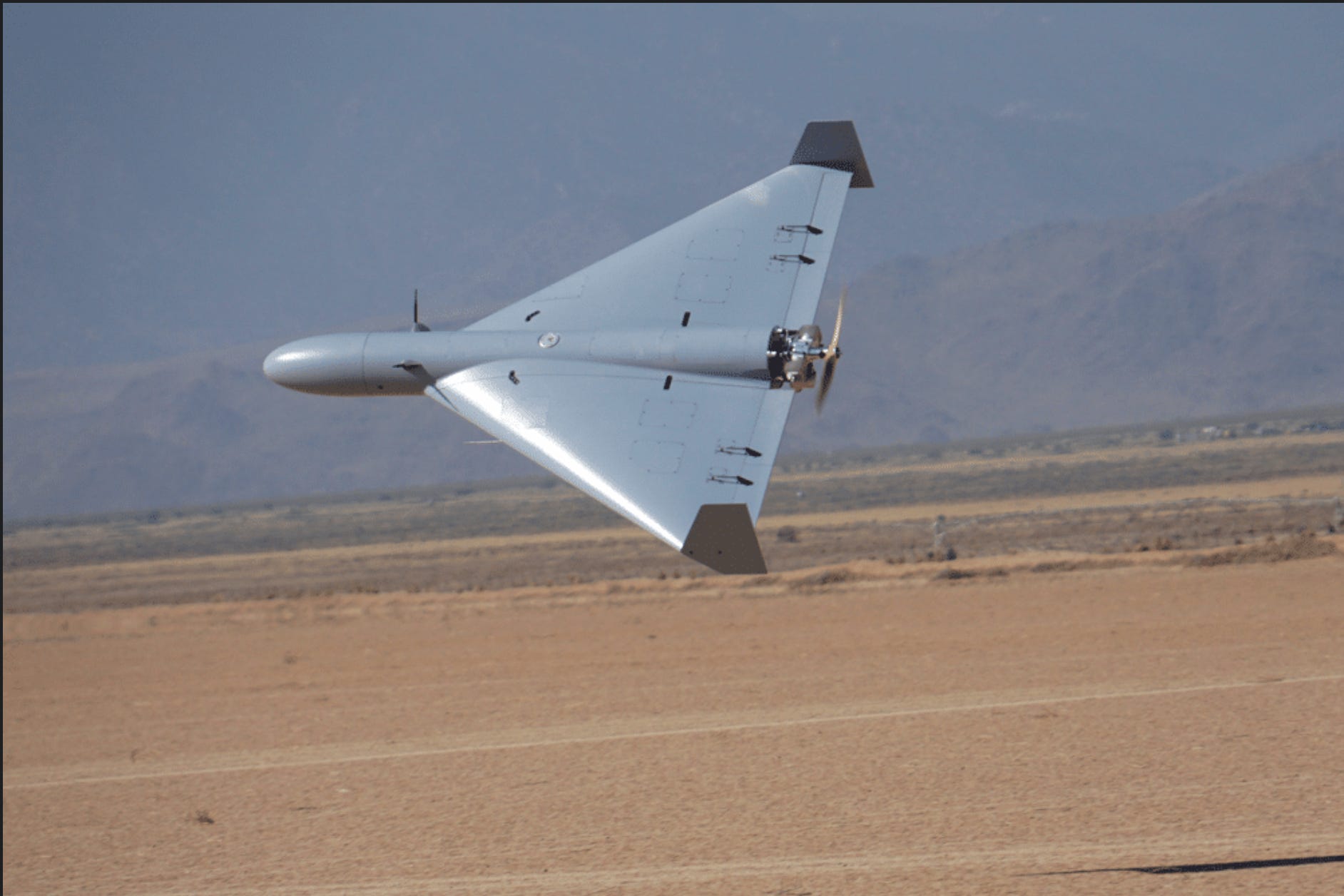
That gap between total obscurity and first combat use in under a year is the story. Not just as a defense technology headline, but as a case study in what happens when procurement systems designed for the Cold War collide with a world that has already moved on, and a founder with the right product happens to be standing in the right room.
For investors and founders paying attention to the defense industrial base, SpektreWorks is worth understanding precisely because it is the exception that proves how the rules are changing.
From Orbital Sciences to an Obscure Arizona Shop
Daniel Laks does not fit the profile of a hot shot defense tech start-up.
He spent seven years as a senior guidance, navigation, and control engineer at Orbital Sciences; the kind of deeply technical GN&C work that involves keeping spacecraft pointed in the right direction under violent conditions. In 2015, he spent seven months at 3D Robotics, Chris Anderson’s open-source drone company that was in the process of being outcompeted into irrelevance by DJI. Within the same year, Laks co-founded SpektreWorks in Scottsdale, Arizona with Brad Golding and Jeremy Wagoner.
The founding thesis, as best as can be reconstructed from public records, was not defense contracting. SpektreWorks described itself for years as an “engineering services company” specializing in “commercial UAS applications.” Its LinkedIn page, unchanged until 2025, used the language of a boutique consultancy, not a weapons manufacturer.
What changed was Ukraine.
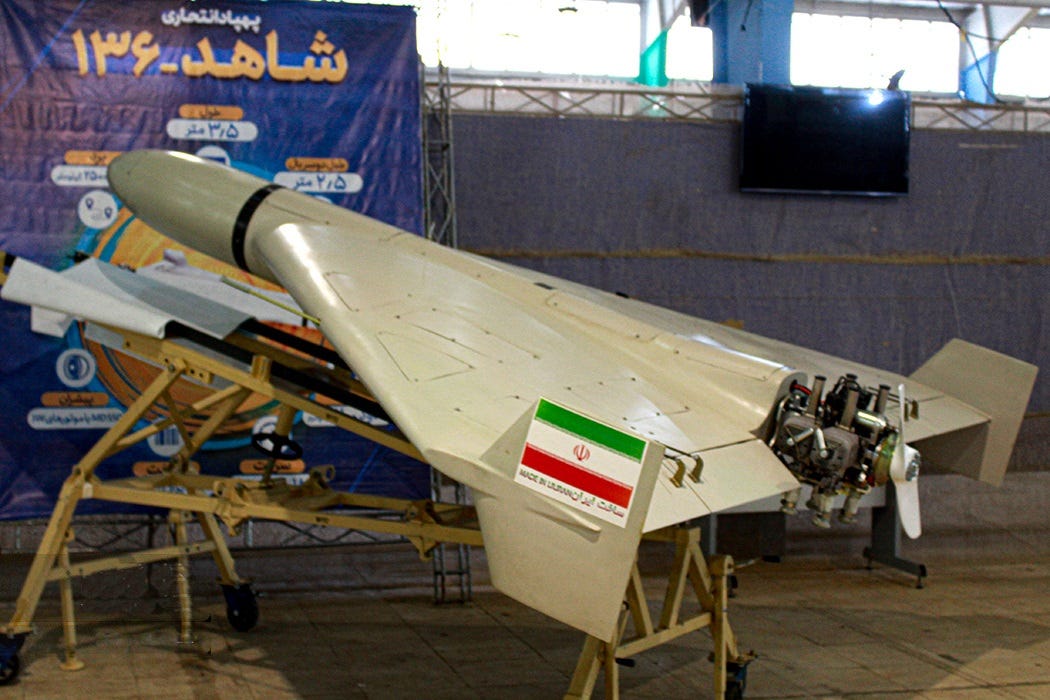
When Russia began deploying Iran’s Shahed-136 one-way attack drones at scale in October 2022, it created a demand signal that anyone paying attention could read. American air defense units suddenly needed realistic surrogates (training targets that behaved like the real threat) and there was essentially nothing in the U.S. defense catalog that filled that role.
SpektreWorks, with Laks’ autopilot expertise and the team’s composite airframe capabilities, reverse-engineered the Shahed and called the product the FLM-136, marketed for “authentic threat emulation.” The revenue this generated was modest: estimates put the company at roughly $2 million in annual revenue heading into 2025. But the product existed. And it flew.
That mattered more than the revenue.
Seven Months from Pentagon Courtyard to Iranian Airspace
In July 2025, Defense Secretary Pete Hegseth stood in the Pentagon courtyard holding a LUCAS drone (SpektreWorks’ weaponized evolution of the FLM-136) and announced a directive called “Unleashing U.S. Military Drone Dominance.“
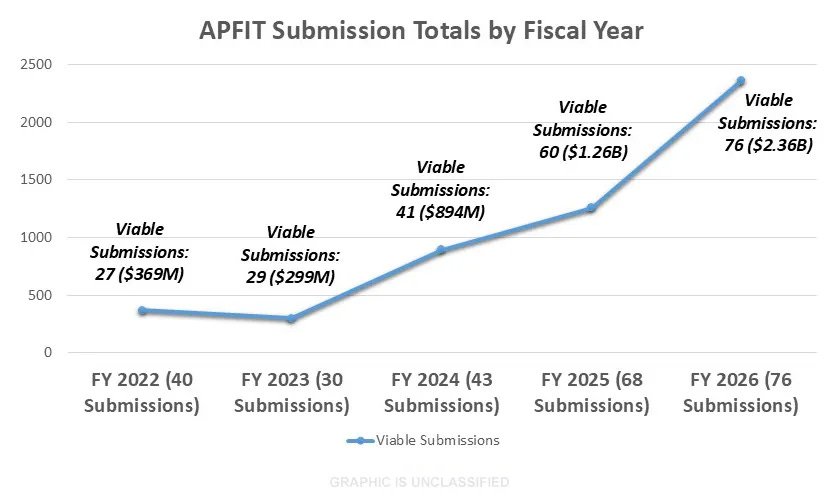
Eight days later, SpektreWorks received a $30 million APFIT contract through the Army Contracting Command. Seven months after that, their platform was flying combat missions over Iran.

Photo courtesy of Business Insider
The mechanism that made this possible is worth understanding in detail, because it is the mechanism that will define the next decade of defense startup formation.
APFIT (Accelerate the Procurement and Fielding of Innovative Technologies) is not a traditional defense contract. It is an authority designed specifically to compress the space between prototype and fielding, cutting around the standard acquisition process that routinely turns promising technology into decade-long programs of record.
The on-ramp that got SpektreWorks into the APFIT pipeline was T-REX: the Technology Readiness Experimentation event run by the Office of the Under Secretary of Defense for Research and Engineering, held at Camp Atterbury, Indiana. T-REX operates at Technology Readiness Levels 4 through 6 (past early concept, not yet fully mature) and puts companies directly in front of the program offices that control APFIT funding.
SpektreWorks showed up to T-REX 25-2 in the summer of 2025 with a flying airframe and a straightforward pitch: we already built a Shahed surrogate for training. We can weaponize it. The production facility was still “at the CGI animation stage,” per one observer on social media at the time. It didn’t matter. The product answered an obvious operational question at the exact moment the Pentagon was being reorganized to move fast.
This is not a story about a company that navigated the defense acquisition system. It is a story about a company that caught the system at the precise moment it was being redesigned to find companies exactly like them.
What the Hiring Data Tells You That the Headlines Don’t
Wall Street analysts who cover defense primes build models on revenue, backlog, and margin. For a company like SpektreWorks (private, tiny, pre-institutional) the signals are different. The most useful data is in the job postings.
In July 2025, simultaneous with the APFIT contract announcement, SpektreWorks posted a UAS Technician role on sUAS News. The job description asks one person to assemble “airframes, payloads, avionics, propulsion, and ground control systems;” every major subsystem of a Group 3 UAS in a single role. That is not the hiring pattern of a company with a divided production line. It is the hiring pattern of a company that just got money and needs hands that can do everything immediately. The pay range started at $24–$31 per hour, climbed to $30–$35 per hour within roughly 90 days; a signal that the initial rate was not competitive in a Phoenix aerospace labor market that includes Honeywell, Boeing, and multiple established primes.
The company’s headcount tells a similar story. Craft.co lists five employees; RocketReach lists fifteen, paired with the pre-contract $2 million revenue figure. As I checked Linkedin this morning it currently has 13 associated people, with two of the co-founders not being listed, so my final assumption is that this company (which is supplying an ongoing conflict) has only 15 people.
I want to take a moment to let that soak in. 15 people.
Compare that to Vector Defense that I profiled last week, which has 72 people and $61 million in venture capital funding. This is a bootstrapped business that is fielding munitions for the military. This is what a successful new entrant looks like.

The most revealing hire is not a technician at all: in October 2025, three months after receiving a $30 million contract, SpektreWorks added an Accounting Controller. A Controller is the hire you make when the government is about to start asking questions about your financial infrastructure. It is not a hire you make speculatively.
What is conspicuously absent from SpektreWorks’ public hiring record is equally telling: no Program Manager, no Contracts Officer, no Quality Assurance Engineer, no Supply Chain lead. These are the functions a company needs to navigate DFARS compliance, manage deliverable schedules, and scale production to multiple customers. Their absence either means those gaps are being filled through the founders’ personal networks, or they are coming and have not yet been publicly posted. For investors underwriting a thesis that this company becomes a durable defense supplier rather than a one-contract wonder, those functions are the operational infrastructure that makes the difference.
The Competitive Landscape Is More Complicated Than It Looks
SpektreWorks is not the only American company in this market.
The competitive structure has two distinct tiers, and the dynamics in each are different.

In the threat emulation segment (the FLM-136 market) the primary competitor is Griffon Aerospace, an Alabama-based manufacturer with over 12,000 UAS systems delivered across its history. Griffon unveiled the MQM-172 Arrowhead in August 2025, a Shahed-class platform with a 100-pound payload capacity and performance specifications that more closely match the actual Iranian drone. The Aviationist noted that SpektreWorks’ FLM-136 “falls short of some of the Shahed-136’s performance characteristics,” making it potentially unsuitable for the Air Force’s August 2025 RFI seeking a “1:1 exact replica.” Griffon has more institutional credibility, better specs for the high-fidelity requirement, and a longer production history. SpektreWorks got there first, through a different pathway entirely, nine months earlier.
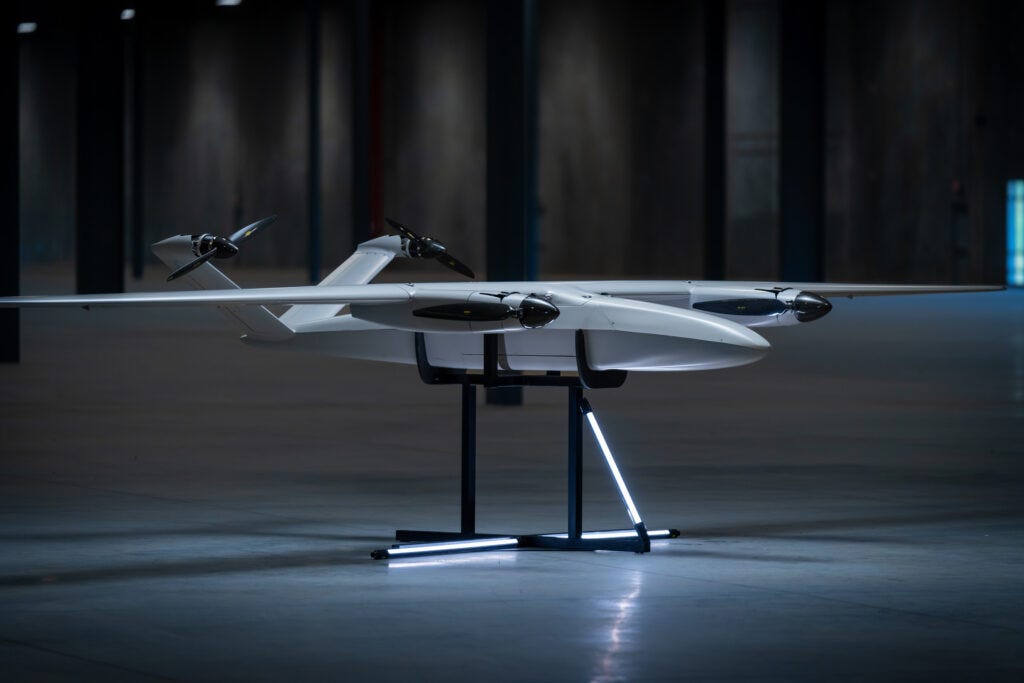
In the one-way attack segment (the combat market) the competition is structured by the Pentagon’s explicit decision to avoid single-source dependency. Col. Nicholas Law of OSW(R&E) stated plainly that LUCAS “is not a single manufacturer: it’s designed to go to multiple manufacturers to be built in mass quantities.” The Defense Innovation Unit’s Project Artemis, announced in March 2025, selected four companies (AeroVironment, Dragoon, and two unnamed Ukrainian firms partnered with Auterion and Swan) for longer-range one-way platforms with GPS-denied operation. Auterion publicly completed its Artemis platform in October 2025 with a 1,000-mile range and 40-kilogram payload; dramatically exceeding LUCAS’ current specifications.
The investment implication is uncomfortable but important: SpektreWorks operates in a market the Pentagon has deliberately designed to be commoditized.
The DoD’s stated target of 200,000 drones by 2027 is a production volume number, not a supplier exclusivity commitment. Any margin that exists in airframe manufacturing in this segment will be competed away as production scales. The durable value in this ecosystem (if it exists) likely lives in the autonomy and navigation software stack, the MUSIC mesh network integration that enables swarm coordination, and the threat emulation recurring revenue stream as LUCAS proliferates and training demand grows alongside it.
The Moat That Won’t Last Forever
SpektreWorks holds one competitive advantage that no amount of specification comparison can currently replicate: their platform has been used in combat.
As of February 28, 2026, LUCAS is the only American-made one-way attack drone with a confirmed operational record. In defense procurement language, “combat proven” is not a marketing phrase, it is a risk reduction argument that dramatically changes the calculus for a program office considering a follow-on contract. Choosing a competitor over SpektreWorks now requires a program officer to explicitly accept that their alternative platform is less validated than a system that has already performed in a real strike environment.
That window is probably 12 to 18 months. If Griffon or an Artemis winner achieves combat use (or if Congress directs a competitive multi-vendor LUCAS production solicitation) the first-mover advantage erodes. The more interesting question for analysts watching this space is whether SpektreWorks can convert its combat credibility into the operational infrastructure (program management, quality systems, supply chain, manufacturing scale) necessary to compete for volume contracts before a better-resourced competitor catches up.
The hiring record suggests they are building that infrastructure in real time, under contract pressure, with a team that was doing bench-to-sky assembly less than a year ago. That is not an insurmountable problem. It is, however, the problem.
Daniel Laks spent seven years learning how to keep satellites on course at Orbital Sciences. He spent seven months in 2015 absorbing how commercial drone companies think about autonomy and autopilots at 3D Robotics. He spent the next decade quietly building threat emulation hardware in Scottsdale while most of the defense world wasn’t watching. And then, in seven months, his company went from a Pentagon courtyard demonstration to a combat mission over Iran.
The question for investors is not whether that trajectory is remarkable. It obviously is. The question is what comes next and whether a company built for speed can build the systems required to sustain what the speed created.
I totally agree on your points. Not happy about this action but still the subject matter is of critical importance.
Outstanding reporting and outstanding work by the team