
Interceptors
The Pentagon Is Running Low on Ammo But The Market Already Has the Answer.

BLUF: Iran’s opening salvo in Operation Epic Fury (roughly 2,000 Shaheds and 500 ballistic missiles in the first 100 hours) burned through an estimated $1.7 billion in U.S. interceptors at exchange ratios as lopsided as 210-to-1, exposing a structural crisis that has been hiding in plain sight for years. The Pentagon is consuming irreplaceable interceptor stocks faster than domestic production lines can replenish them, with THAAD delivery gaps not closing until April 2027 and PAC-3 production only now beginning a multi-year ramp. The solutions exist and are already combat-proven: Ukrainian drone manufacturers with teams of 25 engineers are producing $2,500 kinetic interceptors at 100 units per day, Israel’s Iron Beam is intercepting threats for roughly $3 in electricity, and Epirus’s directed-energy system is defeating drone swarms with a marginal cost per kill approaching zero.
On Saturday, February 28th, I woke up on the East Coast at 6:00 a.m.
While my family was still asleep, I made coffee and sat down to read the morning news, only to find the headlines filled with news of the U.S.-Iran war.
I was somewhat shocked but in many ways not surprised that it had finally come to this.
Like most of my peers, when I served we all took turns flying through the Strait of Hormuz, escorting U.S. ships while Iran would bring out its planes, ships, and fast-attack boats to demonstrate a show of force.
It was normal for them to point weapons at us and our allies. They flew drones over the carrier strike group regularly, and we were tasked with tracking and escorting these low-cost drones as they threatened our more expensive assets in the region.
Even back in 2019, as a young pilot, I was acutely aware of the cost asymmetry between our weapons and platforms and those of Iran. As a fresh lieutenant, I felt compelled to write about it in our community publication, Rotor Review, which you can read here: Rotor Review 2019.
My argument was simple: we need low-cost solutions to combat Iran’s low-cost weapons inventory. My writing fell on deaf ears, and nothing changed. Such is the world.
This story, and the topic of cost asymmetries, is one that is near and dear to me: I’ve lived it.
While it may be seven years too late, I am hopeful that this time we will finally make the necessary changes.
Operation Epic Fury
At 1:15 in the morning on February 28, more than 100 American aircraft launched from land and sea (fighters, tankers, bombers from the continental United States, unmanned platforms) forming a single synchronized wave over Iran.
Within hours, Iran’s Supreme Leader was dead.
Within days, the United States was racing to figure out whether it had enough missiles left to finish the war it had just started.
That is the paradox at the center of Operation Epic Fury, the most significant American military action since the Iraq War. The United States and Israel struck Iran with overwhelming force. Iran struck back: not with a matching show of force, but with a calculated act of economic warfare. In the first 100 hours of the conflict, Iran fired more than 500 ballistic missiles and roughly 2,000 Shahed drones at targets across nine countries simultaneously: Bahrain, Iraq, Jordan, Kuwait, Qatar, Saudi Arabia, the UAE, Oman, and Israel.
Iran’s math was not designed to win every battle. Rather it was designed to drain magazines.
It worked. The United States and its Gulf partners burned through an estimated $1.7 billion in interceptors in those first 100 hours alone: $3.1 billion in total munitions replenishment costs, with another $758 million per day ongoing. A THAAD radar at Al-Udeid Air Base in Qatar was destroyed; a $1.1 billion asset, gone in a single strike.
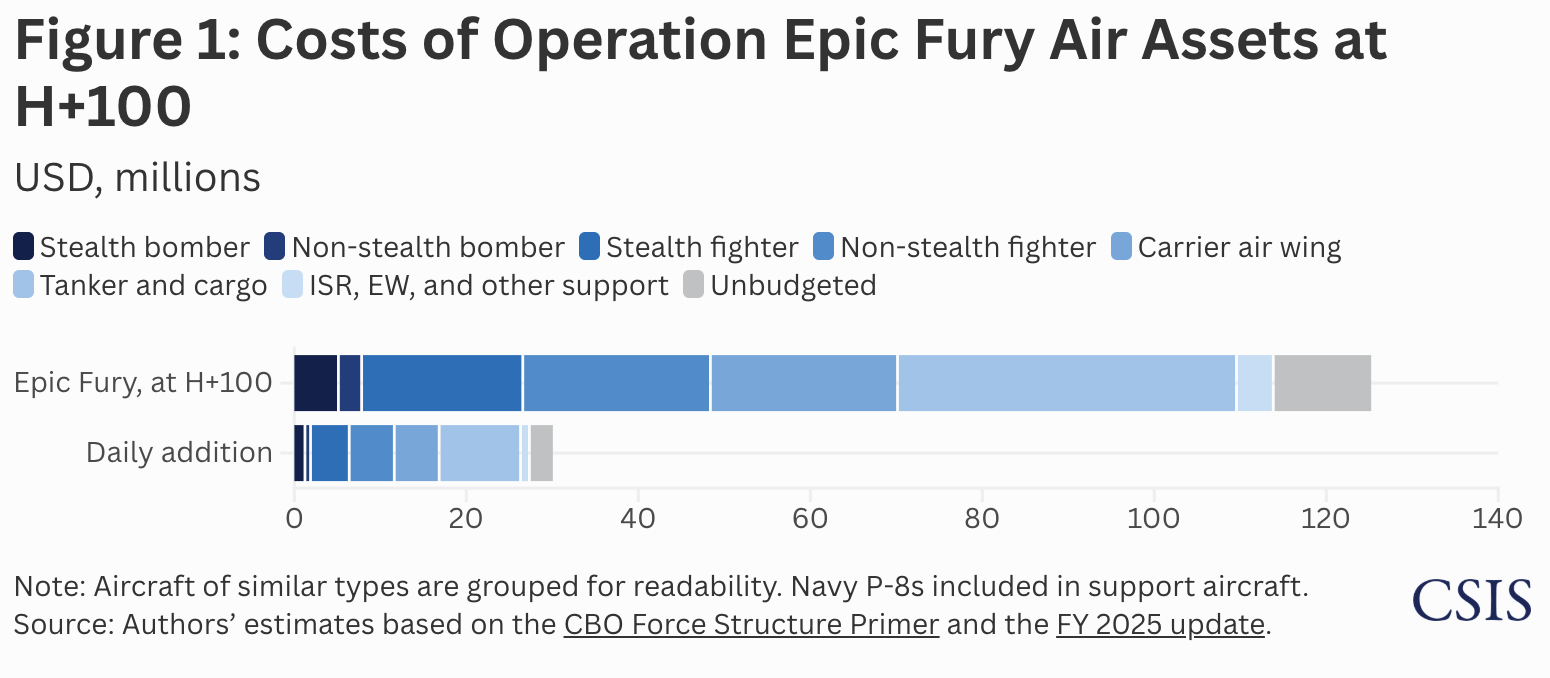
Note: This is truly great analysis by the CSIS team. Worth reading the full article here
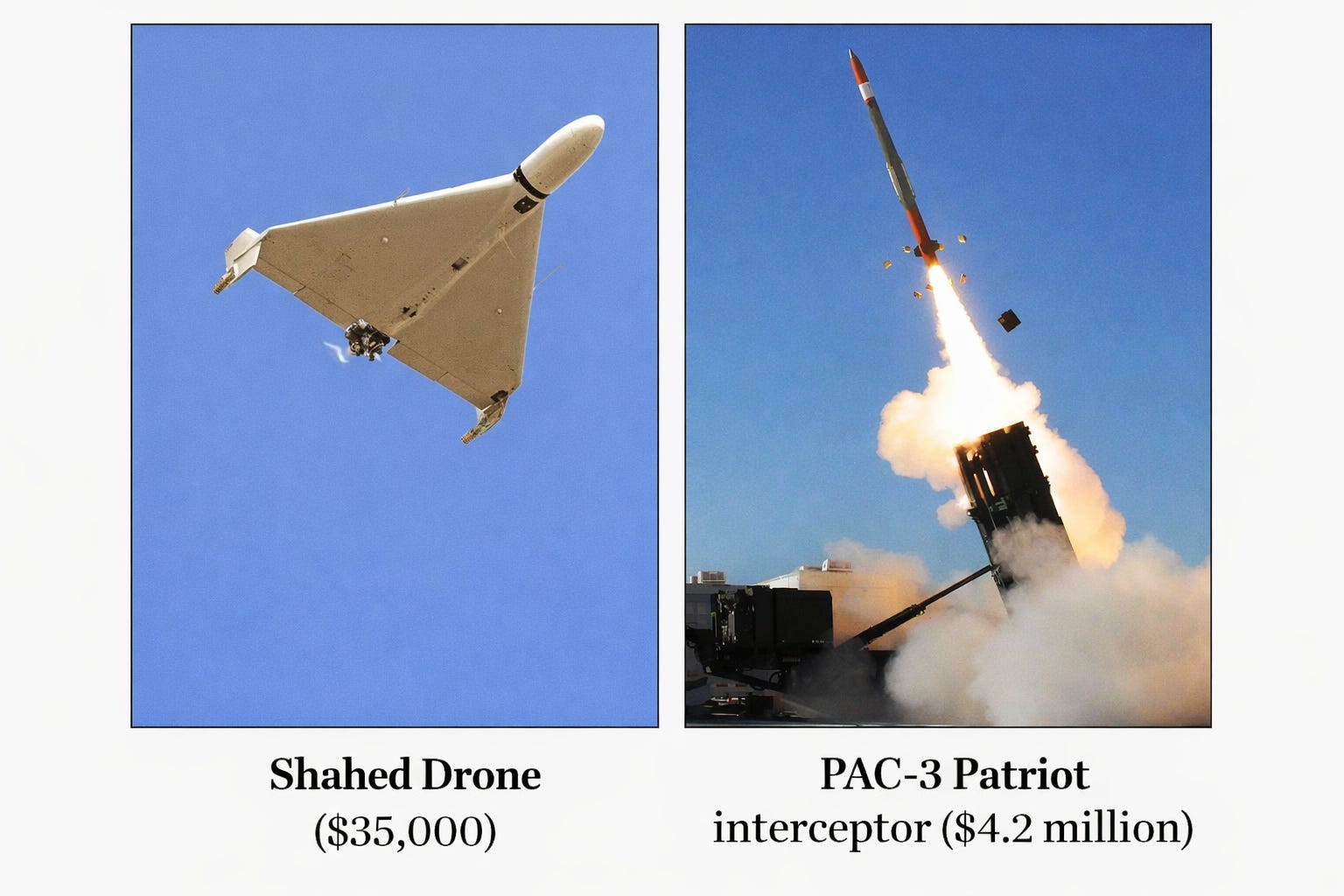
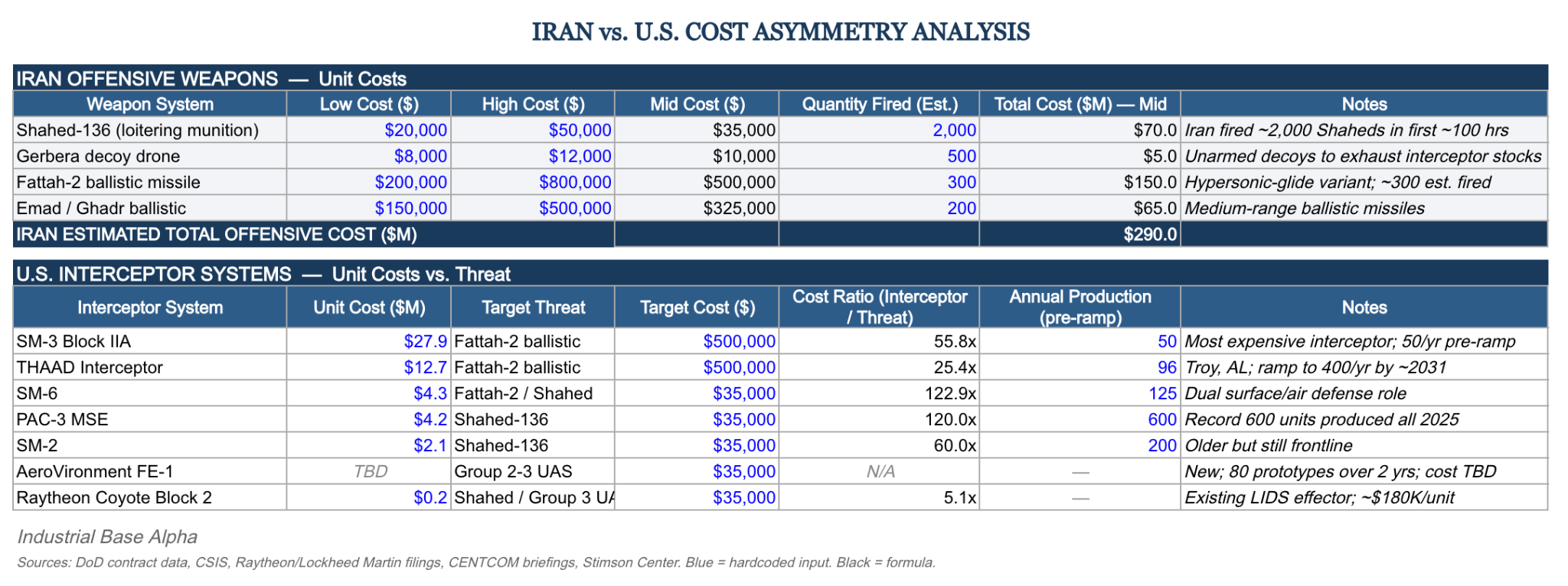
A single Shahed drone costs Iran approximately $20,000 to $50,000 to manufacture. A single PAC-3 Patriot interceptor costs the United States $4.2 million. A single SM-3 Block IIA (the Navy’s top-tier ballistic missile interceptor) costs $27.9 million.⁴ For every dollar Iran spent on drones in this conflict, the UAE spent between $20 and $28 to intercept them, according to Kelly Grieco at the Stimson Center. The Economist called it “using Ferraris to intercept e-bikes.”
For every dollar Iran spent on drones, the UAE spent $20 to $28 to intercept them. The Economist called it ‘using Ferraris to intercept e-bikes.’
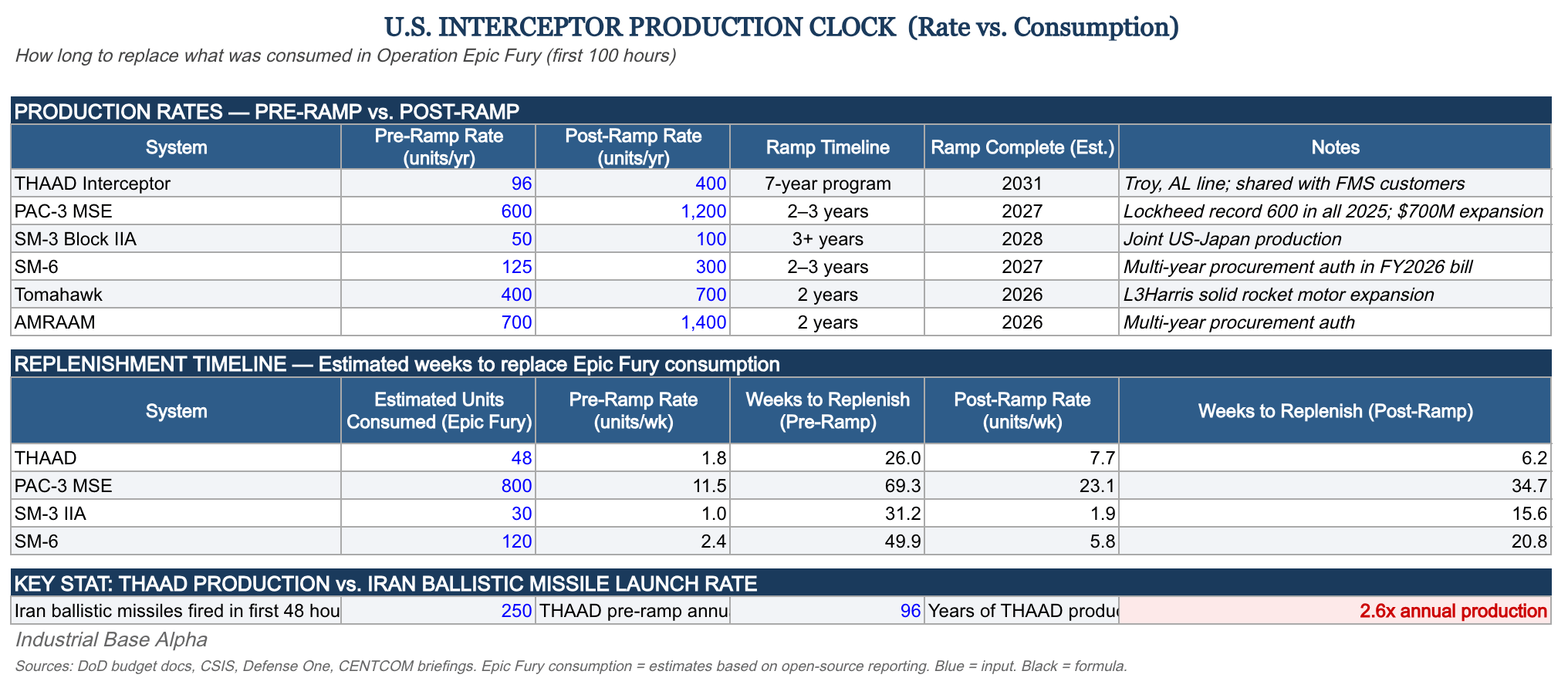
The production numbers make this worse. At pre-ramp rates, the United States manufactured roughly 96 THAAD interceptors per year or one every four days. Iran fired more ballistic missiles in the first 48 hours of this conflict than the U.S. could produce THAAD interceptors in four years.
The gap in U.S. THAAD deliveries is not expected to close until April 2027. Meanwhile, Saudi Arabia, Qatar, and the UAE (all customers for the same Lockheed Martin production line in Troy, Alabama) are competing with the U.S. Army for replenishment of the same missiles being consumed in this war.
Understanding The Market As It Is
None of this is accidental. Iran spent four years watching Russia deploy Iranian-designed Shahed drones against Ukrainian cities in more than 57,000 attacks. Ukraine was the laboratory.
The doctrine is deliberate: fire cheap drones first to exhaust interceptor magazines, then send ballistic missiles through depleted defenses. Iran also deploys Gerbera decoy drones (unarmed, costing roughly $10,000 each) mixed into Shahed salvos specifically to force defenders to expend real interceptors before the armed drones arrive. The effective cost exchange ratio is worse than the headline numbers suggest. And by targeting nine countries simultaneously, Iran forced each nation to drain its own national interceptor stocks all sourced from the same American production lines.
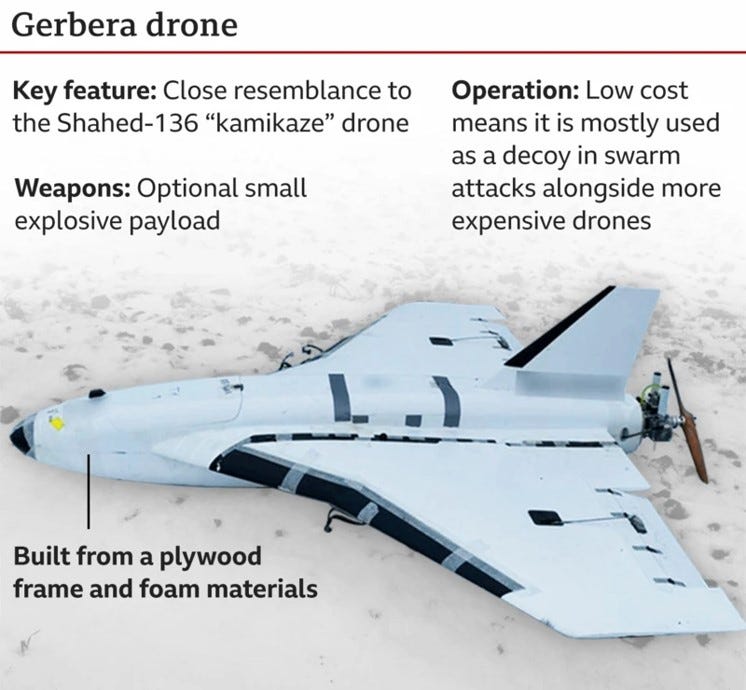
This image comes from a good open source Army website worth checking out
The supply chain vulnerability runs deeper than the prime contractors. Emil Michael, the Under Secretary of War for Research and Engineering and the Pentagon’s chief technology officer, has described meeting a small, wholly-owned family company that manufactures ERAMs (Extended Range Attack Munitions, the kind of missiles the United States has been sending to conflict zones - Go to the 1:10 mark to hear about this part on the podcast) operating with no redundancy, no surge capacity, and no visibility from the defense establishment above them. The fragility runs all the way down to Tier 2 and Tier 3 suppliers who are essentially irreplaceable single points of failure. When multi-year procurement contracts dry up, these companies disappear quietly. Years later, someone notices.
This is what Emil Michael is trying to fix from inside the Pentagon. His stated mandate is to create five more companies (on top of the existing ‘new primes’ of Palantir, SpaceX, and Anduril) that bring genuinely new capabilities into the defense ecosystem. He describes the goal as rebuilding the defense middle market that was hollowed out by three decades of post-Cold War consolidation. The 2026 NDAA has begun lowering the barriers, raising cost accounting thresholds and giving startups a cleaner path to compete for firm fixed-price contracts.
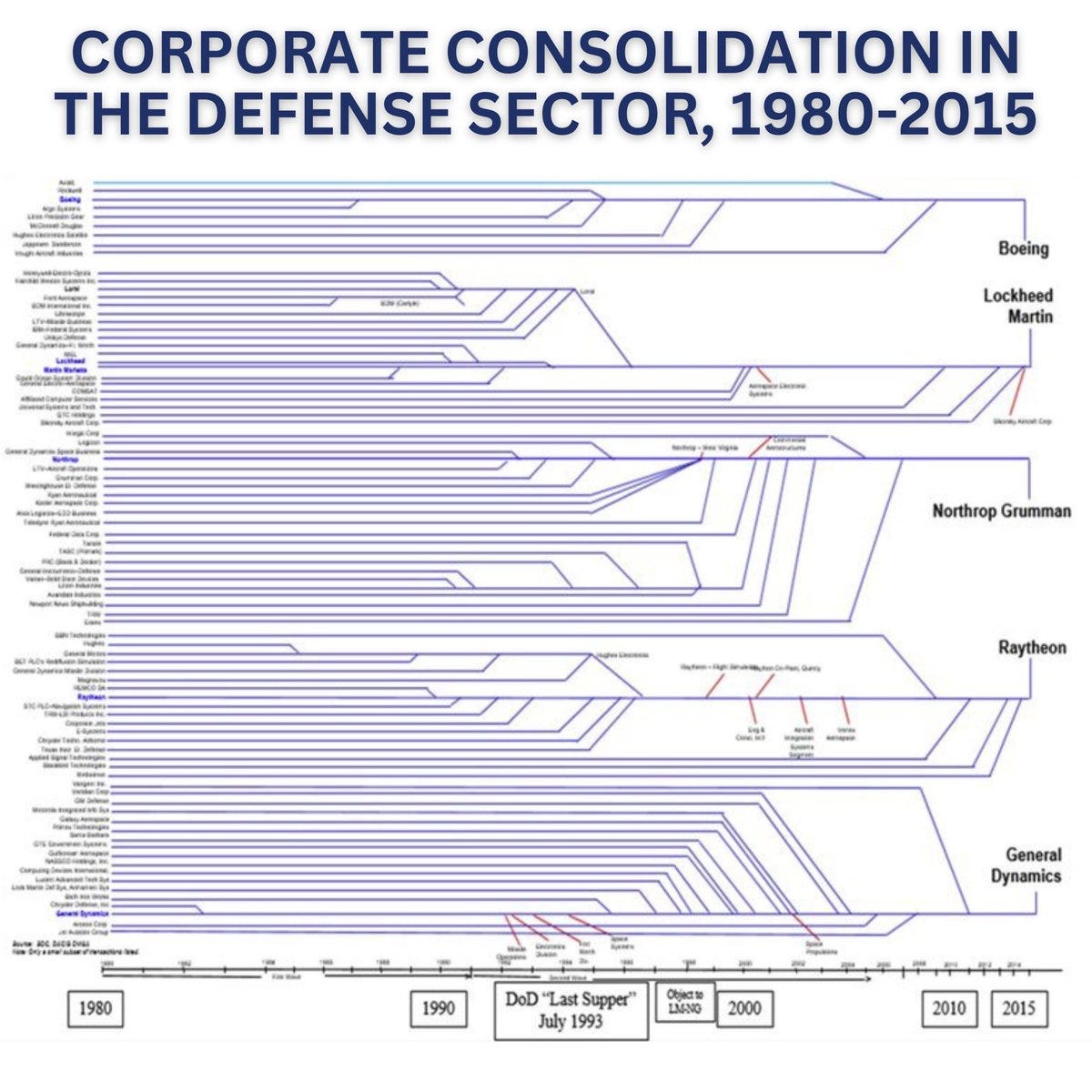
This is what Emil Michael is spending every day trying to unwind
The ramp agreements are real. Congress allocated $25 billion for munitions via reconciliation last summer, and the 2026 spending bill includes multi-year procurement authority for THAAD, PAC-3, SM-3, SM-6, AMRAAM, and Tomahawk.
L3Harris signed a $1 billion deal to expand solid rocket motor production. Raytheon is investing more than $115 million for a 67 percent capacity increase at its Huntsville, Alabama facility.
But these investments are measured in years, not months. Buying $700 million in additional THAAD interceptors at the old rate bought roughly 45 missiles. The ramp from 96 to 400 THAAD per year is a seven-year program. The war started in February.
The Market Already Has The Answer
Here is what makes the current crisis remarkable: the solutions exist.
